Isaiah 40:6-8 (NASB)

Isaiah 40:6-8 (NASB)

6) A voice says, “Call out.”
Then he answered, “What shall I call out?”
All flesh is grass, and all its loveliness is like the flower of the field.

7) The grass withers, the flower fades,
When the breath of the LORD blows upon it;
Surely the people are grass.

8) The grass withers, the flower fades,
But the word of our God stands forever.

Showing posts with label Nebuchadnezzar. Show all posts

Friday, November 24, 2017

Under the watch of a HOLY God (Part II.b)

Defeat is a hard experience. Israel as a whole faced defeat before Ai with Achan's disobedience. It was trying time indeed. But was God still sovereign? Why, you ask, would the God of Isreal allow His people to experience such pain?

Return the question to yourself. What child, although dearly loved and cared for by their parents, lives a life free from pain? Do not children exercise choice in their activities, even choices that may lead to pain? Well, are we kept devoid of choice before God? Surely not. Therefore, pain is something we face . . . ever since the choice Adam and Eve made. Nevertheless, God is sovereign during all times. Israel served a Holy God who gave them real choices with real consequences. Yet, as Israel saw at the 2nd Battle of Ai, this Holy God remained sovereign. The battle was not won by Israel's might or morale (they lost the first time). No, the battle was won by God's hand.

"God of the Hills and Valleys" by Tauren Wells


Facts, Traditions, and Widespread Beliefs regarding the Valley of Achor and Ai: (continued)

  • Geographical City of Ai:
    • Genesis 12:7-9, "So he [Abram] built an altar there to the LORD who had appeared to him. Then he proceeded from there to the mountain on the east of Bethel, and pitched his tent, with Bethel on the west and Ai on the east; and there he built an altar to the LORD and called upon the name of the LORD."
    • Joshua 7:2-5, "Now Joshua sent men from Jericho to Ai, which is near Beth-aven, east of Bethel, and said to them, 'Go up and spy out the land.' So the men went up and spied out Ai. They returned to Joshua and said to him, 'Do not let all the people go up; only about two or three thousand men need go up to Ai; do not make all the people toil up there, for they are few.' So about three thousand men from the people went up there, but they fled from the men of Ai. The men of Ai struck down about thirty-six of their men, and pursued them from the gate as far as Shebarim and struck them down on the descent, so the hearts of the people melted and became as water."
    • Ezra 2:1-29, "Now these are the people of the province who came up out of the captivity of the exiles whom Nebuchadnezzar the king of Babylon had carried away to Babylon, and returned to Jerusalem and Judah, each to his city . . . the sons of Kiriath-arim, Chephirah and Beeroth, 743; the sons of Ramah and Geba, 621; the men of Michmas, 122; the men of Bethel and Ai, 223 . . ."
      • Ai lay above Jericho in altitude (Joshua 7:2-5)
      • Ai lay close to Beth-aven and just east of Bethel (Gen. 12:7-9; Joshua 7:2-5)
      • A mountain lay between Bethel and Abram's Ai (Gen. 12:7-9)
      • Ai was walled with a city gate (Joshua 7:2-5)
      • Ai apparently lay west of a place called Shebarim (assuming the men of Israel fled back eastward to camp at Gilgal--see following passages), which was close to a descending slope (Joshua 7:2-5)
      • Ai was repopulated by Israelites sometime after Joshua's conquest and prior to Babylonian captivity (Ezra 2:1-29)
    • Joshua 8:10-29, "he [Joshua] went up with the elders of Israel before the people to Ai. Then all the people of war who were with him went up and drew near and arrived in front of the city, and camped on the north side of Ai. Now there was a valley between him and Ai. And he took about 5,000 men and set them in ambush between Bethel and Ai, on the west side of the city . . . and Joshua spent that night in the midst of the valley. It came about when the king of Ai saw it, that the men of the city hurried and rose up early and went out to meet Israel in battle, he and all his people at the appointed place before the desert plain. But he did not know that there was an ambush against him behind the city. Joshua and all Israel pretended to be beaten before them, and fled by the way of the wilderness . . . When Joshua and all Israel saw that the men in ambush had captured the city and that the smoke of the city ascended, they turned back and slew the men of Ai. The others came out from the city to encounter them, so that they were trapped in the midst of Israel, some on this side and some on that side; and they slew them until no one was left of those who survived or escaped . . . All who fell that day, both men and women, were 12,000—all the people of Ai . . . Israel took only the cattle and the spoil of that city as plunder for themselves, according to the word of the LORD which He had commanded Joshua. So Joshua burned Ai and made it a heap . . ."
      • A large valley lay on the north side of Ai.
      • The valley north of Ai led to a desert plain.
      • Concealing terrain lay on the west of Ai.
      • Cattle were taken alive from Ai.
      • The ruins of Ai were plundered.
      • Ai's city gate was on the north side.
      • Ai was burned.
      • Both men and women lived at Ai
    • Encyclopaedia Britannica - Modern archaeology associates ancient Ai with et-Tell. But those ruins appear to only be from before and after Israelite conquest. Thus many archaeologists assume that Ai was identified by the Israelites with Bethel, placing Bethel-Ai at Beitin 1.5 miles west of et-Tell. This does not cohere with Joshua identifying Ai to lie east of Bethel).
    • Dr. David Livingston - considers the Biblical account to be historical and favors Khirbet Nisya (Kh. Nisya) as site of ancient Ai:
      • Kh. Nisya was ~5 acres in size, compared to the 11 acre size of "greater" Gibeon (Joshua 10:2)
      • Kh. Nisya appears to be a reasonable topographical fit for Joshua's Ai.
      • Kh. Nisya also reveals evidence of Israelite resettlement just prior and immediately after the Babylonian Captivity, which Bryant Wood's Kh. el- Maqatir does not show thus far. Upcoming website on Kh. Nisya dig site: "Ai Archaeological Park"
      • However, Kh. Nisya shows no sign of walls and a gate at time of Joshua
      • Dr. Livingston originally placed Beth-aven at Beitin, but now places Beth-aven at Kh. el-Maqatir. This would still hardly make Ai (if Ai was at Kh. Nisya) close to Beth-aven compared to Bethel (at el-Bireh), as mapped below. So, placement of Beth-aven at Kh. el-Maqatir and Ai at Kh. Nisya does not seem to fit the description in Joshua 7:2
      • Also, Dr. Livingston does not mention evidence of Kh. Nisya having been burned.
      • Region of et-Tell, Kh. Nisya, and Kh. el-Maqatir (Biblicalarcheology.org).
        Land elevation can be checked by clicking on terrain on elevationmap.net maps.
    • Dr. Bryant Wood - places Ai at Khirbet el-Maqatir. The Bryant Wood team has found:
      • Remains of a gate facing north at this site
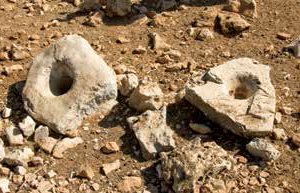
Socket Stones
Gate Socket Stones at Kh. el-Maqatir (Answers in Genesis)
Infant burial jar found at Kh. el-Maqatir (Biblearchaeology.org)
      • Infant burial jar found at Kh. el-Maqatir affirms that both men and women were living there.
      • Kh. el-Maqatir remained a desolate ruin after destruction by fire in the time of Joshua.
      • This site fits the Joshua account well. The mountain between Ai and Bethel noted in Genesis may be explained by an earlier Ai ("Getting Archaeology Right at Ai", Footnote 2) being located at et-Tell. This would leave the sites of either Baytin/Beitin or Kh. el-Maqatir as the mountain Abram stood on with Ai on the east and Bethel on the west.


Sunday, June 18, 2017

Under the watch of a HOLY God.

"Achan . . . Achan . . . why?"

Upon the fall of Jericho, the Sons of Israel faced the Canaanite city of Ai. They were confident after seeing the wall of Jericho collapse. God had fought for them. So they set out for Ai with only a partial contingent of their fighting force as the men of Ai were "few" in number. But . . . Israel was repelled and fled from the men of Ai.

Achan, of the tribe of Judah, had taken spoil from the ruins of Jericho. God had placed all Jericho under "ban", which meant it belonged to Him. No one in Israel was to seize spoil for themselves. All gold, silver, bronze, and iron were to be brought into the Lord's treasury for use in service of the Lord. But when Achan saw gold, silver, and a fine mantle in the ruins of Jericho, he coveted them and took these things for himself.

Seeing Achan's deed, God retracted His [protecting] presence from Israel. Therefore, Israel fled and fell before Ai. Joshua cried out to God in dismay--and learned of Achan's disobediance. Achan had taken what belonged to the Lord. God's [protection] would not rest on Israel while Achan remained within the camp. Only when death and fire took Achan, his complicit household, and all his belongings did God restore His [protecting] presence to Israel. With God's help, Israel defeated Ai.

Thus runs the story of Achan and Ai. To understand, one must investigate the story's context within the whole of Scripture. Was the story history, fiction, or a combination of the two?

"Holy, Holy, Holy" as sung by Audrey Assad


Old Testament references to Achan and Ai (no New Testament references found):
  • Joshua 7:1-11, "But the sons of Israel acted unfaithfully in regard to the things under the ban, for Achan, the son of Carmi, the son of Zabdi, the son of Zerah, from the tribe of Judah, took some of the things under the ban, therefore the anger of the LORD burned against the sons of Israel.
          Now Joshua sent men from Jericho to Ai, which is near Beth-aven, east of Bethel, and said to them, 'Go up and spy out the land.' So the men went up and spied out Ai. They returned to Joshua and said to him, 'Do not let all the people go up; only about two or three thousand men need go up to Ai; do not make all the people toil up there, for they are few.' So about three thousand men from the people went up there, but they fled from the men of Ai . . .
          Then Joshua tore his clothes and fell to the earth on his face before the ark of the LORD until the evening, both he and the elders of Israel; and they put dust on their heads. Joshua said, 'Alas, O Lord GOD, why did You ever bring this people over the Jordan, only to deliver us into the hand of the Amorites, to destroy us?' . . .
          So the LORD said to Joshua, 'Rise up! Why is it that you have fallen on your face? Israel has sinned, and they have also transgressed My covenant which I commanded them. And they have even taken some of the things under the ban and have both stolen and deceived.'"
    • Achan - a historical man
    • Why name the father, grandfather, great grandfather, and Israelite tribe of an imaginary man?
    • What benefit is there in writing a story about an imaginary man that makes your people look frail in battle? What people would do this?
    • What benefit is there in writing a story about an imaginary man that makes your national leader look weak?
    • Ai - a historical city
    • Why specify the location of Ai if Ai was an imaginary city?
    • Why detail the words of the Israelite spies if they were spying out an imaginary Ai?
    • Why number the Israelite soldiers who fought Ai if Ai was imaginary?
  • Joshua 22:16-25, "Thus says the whole congregation of the LORD, 'What is this unfaithful act which you have committed against the God of Israel, turning away from following the LORD this day, by building yourselves an altar, to rebel against the LORD this day?' . . . do not rebel against the LORD, or rebel against us by building an altar for yourselves, besides the altar of the LORD our God. Did not Achan the son of Zerah act unfaithfully in the things under the ban, and wrath fall on all the congregation of Israel? And that man did not perish alone in his iniquity.'
          Then the sons of Reuben and the sons of Gad and the half-tribe of Manasseh answered and spoke to the heads of the families of Israel. 'The Mighty One, God, the LORD, the Mighty One, God, the LORD! He knows, and may Israel itself know . . . truly we have done this out of concern, for a reason, saying, "In time to come your sons may say to our sons, 'What have you to do with the LORD, the God of Israel? For the LORD has made the Jordan a border between us and you, you sons of Reuben and sons of Gad; you have no portion in the LORD.' So your sons may make our sons stop fearing the LORD."'"
    • Achan - a historical man
    • How can real tribes be rebellious like an imaginary Achan?
    • Why name the obscure ancestor of an imaginary Achan?
    • Why would Israel heed the death toll of an imaginary Achan's rebellion?
    • Why fear God as a God who "knows" in the context of an imaginary Achan?
  • I Chronicles 2:1-8, "These are the sons of Israel: Reuben, Simeon, Levi, Judah, Issachar, Zebulun, Dan, Joseph, Benjamin, Naphtali, Gad and Asher.
          The sons of Judah were Er, Onan and Shelah; these three were born to him by Bath-shua the Canaanitess. And Er, Judah’s firstborn, was wicked in the sight of the LORD, so He put him to death. Tamar his daughter-in-law bore him Perez and Zerah. Judah had five sons in all.
          The sons of Perez were Hezron and Hamul. The sons of Zerah were Zimri, Ethan, Heman, Calcol and Dara; five of them in all. The son of Carmi was Achar, the troubler of Israel, who violated the ban. The son of Ethan was Azariah."
    • Achan - a historical man
    • Why name the father of an imaginary Achan?
    • Why list an imaginary Achan in the real genealogies of Israel?
    • Why name an imaginary Achan to be a descendant of the real tribe of Judah?
    • Why name an imaginary "troubler of Israel" in the royal tribe of David and Christ? How would this bring honor to that tribe?
  • Joshua 9:1-6, "Now it came about when all the kings who were beyond the Jordan, in the hill country and in the lowland and on all the coast of the Great Sea toward Lebanon, the Hittite and the Amorite, the Canaanite, the Perizzite, the Hivite and the Jebusite, heard of it, that they gathered themselves together with one accord to fight with Joshua and with Israel. When the inhabitants of Gibeon heard what Joshua had done to Jericho and to Ai, they also acted craftily and set out as envoys, and took worn-out sacks on their donkeys, and wineskins worn-out and torn and mended, and worn-out and patched sandals on their feet, and worn-out clothes on themselves; and all the bread of their provision was dry and had become crumbled. They went to Joshua to the camp at Gilgal and said to him and to the men of Israel, 'We have come from a far country; now therefore, make a covenant with us.'"
    • Ai - a historical city
    • How could the fate of an imaginary Ai spread throughout a real geographical land?
    • Why name all the peoples that heard of the fate of an imaginary Ai?
    • Why associate an imaginary Ai with a real Jericho?
    • How could an imaginary Gibeon hear the fate of a real Jericho?
    • What did the real Gibeonites have to fear from the fate of an imaginary Ai?
    • Wouldn't it be deceitful to write of the real leader Joshua overthrowing an imaginary Ai? How would such deceit prove helpful to a nation claiming to serve the one true God?
  • Joshua 10:1-5, "Now it came about when Adoni-zedek king of Jerusalem heard that Joshua had captured Ai, and had utterly destroyed it (just as he had done to Jericho and its king, so he had done to Ai and its king), and that the inhabitants of Gibeon had made peace with Israel and were within their land, that he feared greatly, because Gibeon was a great city, like one of the royal cities, and because it was greater than Ai, and all its men were mighty. Therefore Adoni-zedek king of Jerusalem sent word to Hoham king of Hebron and to Piram king of Jarmuth and to Japhia king of Lachish and to Debir king of Eglon, saying, 'Come up to me and help me, and let us attack Gibeon, for it has made peace with Joshua and with the sons of Israel.' So the five kings of the Amorites, the king of Jerusalem, the king of Hebron, the king of Jarmuth, the king of Lachish, and the king of Eglon, gathered together and went up, they with all their armies, and camped by Gibeon and fought against it."
    • Ai - a historical city
    • How could a real Gibeon be greater than an imaginary Ai? How does one compare reality and fiction?
    • Why name five Canaanite kings and the cities they ruled unless those kings really lived?
    • Why name a Caananite king and the real city of Jerusalem he ruled unless that king really lived?
    • How could a real Caananite king hear of the destruction of an imaginary Ai?
    • Why would five real Canaanite kings have cause to fear at the fall of an imaginary Ai?
  • Joshua 12:7-24, "Now these are the kings of the land whom Joshua and the sons of Israel defeated beyond the Jordan toward the west, from Baal-gad in the valley of Lebanon even as far as Mount Halak, which rises toward Seir; and Joshua gave it to the tribes of Israel as a possession according to their divisions, in the hill country, in the lowland, in the Arabah, on the slopes, and in the wilderness, and in the Negev; the Hittite, the Amorite and the Canaanite, the Perizzite, the Hivite and the Jebusite: the king of Jericho, one; the king of Ai, which is beside Bethel, one; the king of Jerusalem, one; the king of Hebron, one; the king of Jarmuth, one . . . the king of Dor in the heights of Dor, one; the king of Goiim in Gilgal, one; the king of Tirzah, one: in all, thirty-one kings."
    • Ai - a historical city
    • Why name an imaginary Ai alongside the real ancient cities of Jericho, Jerusalem, and Hebron?
    • Why specify "thirty-one" city-state kings defeated by Joshua unless those kings and their cities (including Ai) really existed?
    • Why write with geographical detail and drop in the name of an imaginary city Ai?
  • Ezra 2:1-29, "Now these are the people of the province who came up out of the captivity of the exiles whom Nebuchadnezzar the king of Babylon had carried away to Babylon, and returned to Jerusalem and Judah, each to his city. These came with Zerubbabel, Jeshua, Nehemiah, Seraiah, Reelaiah, Mordecai, Bilshan, Mispar, Bigvai, Rehum and Baanah.
          The number of the men of the people of Israel: the sons of Parosh, 2,172; the sons of Shephatiah, 372 . . . the men of Bethlehem, 123; the men of Netophah, 56; the men of Anathoth, 128; the sons of Azmaveth, 42; the sons of Kiriath-arim, Chephirah and Beeroth, 743; the sons of Ramah and Geba, 621; the men of Michmas, 122; the men of Bethel and Ai, 223; the sons of Nebo, 52 . . ."
    • Ai - a historical city
    • Why name Israelite settlers of an imaginary city Ai as captives of the real Babylonian king Nebuchadnezzer? Why give an enemy king that needless extra credit?
    • How could real captives return home to an imaginary city of Ai?
    • Why number captives returning to an imaginary city of Ai?
    • What detail-oriented historian would reference an imaginary city of Ai?
    • If Bethlehem was a real city, why not Ai?

Saturday, June 11, 2016

Two brothers. One people. One God.

Exodus 1:1-12, "Now these are the names of the sons of Israel [Jacob] who came to Egypt with Jacob; they came each one with his household: Reuben, Simeon, Levi and Judah; Issachar, Zebulun and Benjamin; Dan and Naphtali, Gad and Asher. All the persons who came from the loins of Jacob were seventy in number, but Joseph was already in Egypt. Joseph died, and all his brothers and all that generation. But the sons of Israel were fruitful and increased greatly, and multiplied, and became exceedingly mighty, so that the land was filled with them. Now a new king arose over Egypt, who did not know Joseph. He said to his people, 'Behold, the people of the sons of Israel are more and mightier than we. Come, let us deal wisely with them, or else they will multiply and in the event of war, they will also join themselves to those who hate us, and fight against us and depart from the land.' So they appointed taskmasters over them to afflict them with hard labor. And they built for Pharaoh storage cities, Pithom and Raamses. But the more they afflicted them, the more they multiplied and the more they spread out, so that they were in dread of the sons of Israel."

According to Exodus, after Joseph and the Pharaoh he ruled alongside died, things changed for the sons of Israel. They first surpassed the Egyptians in either population, possessions, or both. Then, in fear of their power, the current Egyptian Pharaoh enslaved the descendents of Jacob. Yet, in the midst of this narrative, two names stand out--Moses and Aaron.

Exodus 2:1-10, "Now a man from the house of Levi [descendents of Levi] went and married a daughter of Levi. The woman conceived and bore a son; and when she saw that he was beautiful, she hid him for three months [since the Pharaoh had ordered that newborn Israelite sons be put to death]. But when she could hide him no longer, she got him a wicker basket and covered it over with tar and pitch. Then she put the child into it and set it among the reeds by the bank of the Nile. His sister stood at a distance to find out what would happen to him.
      The daughter of Pharaoh came down to bathe at the Nile, with her maidens walking alongside the Nile; and she saw the basket among the reeds and sent her maid, and she brought it to her. When she opened it, she saw the child, and behold, the boy was crying. And she had pity on him and said, 'This is one of the Hebrews’ children.' . . . and he became her son. And she named him Moses, and said, 'Because I drew him out of the water.'"

Exodus 3:4-4:16, "When the LORD saw that he turned aside to look, God called to him from the midst of the bush and said, 'Moses, Moses!' And he said, 'Here I am.' . . . He said also, 'I am the God of your father, the God of Abraham, the God of Isaac, and the God of Jacob.' Then Moses hid his face, for he was afraid to look at God. The LORD said, 'I have surely seen the affliction of My people who are in Egypt, and have given heed to their cry because of their taskmasters, for I am aware of their sufferings . . . Therefore, come now, and I will send you to Pharaoh, so that you may bring My people, the sons of Israel, out of Egypt' . . . Then Moses said to God, 'Behold, I am going to the sons of Israel, and I will say to them, "The God of your fathers has sent me to you." Now they may say to me, "What is His name?" What shall I say to them?' God said to Moses, 'I AM WHO I AM'; and He said, 'Thus you shall say to the sons of Israel, "I AM has sent me to you."' . . . Then Moses said to the LORD, 'Please, Lord, I have never been eloquent, neither recently nor in time past, nor since You have spoken to Your servant; for I am slow of speech and slow of tongue.' The LORD said to him, 'Who has made man’s mouth? Or who makes him mute or deaf, or seeing or blind? Is it not I, the LORD? Now then go, and I, even I, will be with your mouth, and teach you what you are to say.' But he said, 'Please, Lord, now send the message by whomever You will.' Then the anger of the LORD burned against Moses, and He said, 'Is there not your brother Aaron the Levite? I know that he speaks fluently. And moreover, behold, he is coming out to meet you; when he sees you, he will be glad in his heart. You are to speak to him and put the words in his mouth; and I, even I, will be with your mouth and his mouth, and I will teach you what you are to do. Moreover, he shall speak for you to the people; and he will be as a mouth for you . . ."


What is the siginificance of Moses and Aaron in Scripture outside of the Pentateuch (Genesis, Exodus, Leviticus, Numbers, and Deuteronomy), also called the "Law of Moses" with authorship at least traditionally attributed to Moses?


Moses & Aaron in the context of the Old Testament:
  • Joshua 1:1-7, "Now it came about after the death of Moses the servant of the LORD, that the LORD spoke to Joshua the son of Nun, Moses’ servant, saying, 'Moses My servant is dead; now therefore arise, cross this Jordan, you and all this people, to the land which I am giving to them, to the sons of Israel. Every place on which the sole of your foot treads, I have given it to you, just as I spoke to Moses. From the wilderness and this Lebanon, even as far as the great river, the river Euphrates, all the land of the Hittites, and as far as the Great Sea toward the setting of the sun will be your territory. No man will be able to stand before you all the days of your life. Just as I have been with Moses, I will be with you; I will not fail you or forsake you. Be strong and courageous, for you shall give this people possession of the land which I swore to their fathers to give them. Only be strong and very courageous; be careful to do according to all the law which Moses My servant commanded you; do not turn from it to the right or to the left, so that you may have success wherever you go.'"
    • Moses - portrayed as a historical man.
    • Why add the descriptor "servant of the Lord" following the name of an imaginary character? How could an imaginary person serve the Lord?
    • Why would God directly say that an imaginary person had died?
    • Why would a real, all-powerful God speak to an imaginary person?
    • What encouragement is there for God to say "Just as I have been with" [an imaginary person] "I will be with you"?
    • What reason would there be for Joshua to heed the law commanded by an imaginary person? How could an imaginary person even entrust this law to Joshua?
    • Why juxtapose reference to an imaginary man with reference to the real Jordan River, the real land of Lebanon, the real Euphrates, and the real Hittite people?
    • How could settlement of real land be promised through an imaginary man?
  • I Samuel 12:6-9, "Then Samuel said to all Israel, 'Behold, I have listened to your voice in all that you said to me and I have appointed a king over you. Now, here is the king walking before you, but I am old and gray, and behold my sons are with you' . . . Then Samuel said to the people, 'It is the LORD who appointed Moses and Aaron and who brought your fathers up from the land of Egypt. So now, take your stand, that I may plead with you before the LORD concerning all the righteous acts of the LORD which He did for you and your fathers. When Jacob went into Egypt and your fathers cried out to the LORD, then the LORD sent Moses and Aaron who brought your fathers out of Egypt and settled them in this place. But they forgot the LORD their God, so He sold them into the hand of Sisera, captain of the army of Hazor, and into the hand of the Philistines and into the hand of the king of Moab, and they fought against them.'"
    • Moses and Aaron - portrayed as historical men.
    • Why would an old man tell a fictitious story about imaginary characters named Moses and Aaron to the Israelite people he has led and judged? He would have little personal benefit in old age.
    • Why would Samuel "plead"/argue with the people by talking about imaginary characters? How would such an argument be convincing?
    • Why would it be said that the ompnipotent God sent imaginary men to bring Israel up from Egypt?
    • Why would Samuel, who received direct word from God as a prophet his whole life, indoctrinate Israel with an imaginary story about imaginary characters? Would God blind the eyes of His own people?
    • How could the Israelites forget the Lord their God if the tale of their forefathers witnessing God's wonders was merely imaginary?
  • I Chronicles 1:1-15, "The sons of Levi were Gershon, Kohath and Merari. The sons of Kohath were Amram, Izhar, Hebron and Uzziel. The children of Amram were Aaron, Moses and Miriam. And the sons of Aaron were Nadab, Abihu, Eleazar and Ithamar. Eleazar became the father of Phinehas, and Phinehas became the father of Abishua, and Abishua became the father of Bukki, and Bukki became the father of Uzzi . . . and Ahitub became the father of Zadok, and Zadok became the father of Ahimaaz . . . and Johanan became the father of Azariah (it was he who served as the priest in the house which Solomon built in Jerusalem), and Azariah became the father of Amariah, and Amariah became the father of Ahitub . . . and Seraiah became the father of Jehozadak; and Jehozadak went along when the LORD carried Judah and Jerusalem away into exile by Nebuchadnezzar."
    • Moses and Aaron - portrayed as historical men.
    • Why trace a current priestly line father-to-son from an imaginary character Aaron, brother of an imaginary Moses? One simply cannot justify authority [priestly here] based on an imaginary ancestor, no matter how detailed you are.
    • Why reference the real Temple of Solomon in a fictitious genealogy?
    • Why reference the real captivity of Judah and Jerusalem under the real Bablyonian King Nebuchadnezzar in a fictitious genealogy?
  • I Chronicles 23:1-17, "Now when David reached old age, he made his son Solomon king over Israel. And he gathered together all the leaders of Israel with the priests and the Levites. The Levites were numbered from thirty years old and upward, and their number by census of men was 38,000. Of these, 24,000 were to oversee the work of the house of the LORD; and 6,000 were officers and judges, and 4,000 were gatekeepers, and 4,000 were praising the LORD with the instruments which David made for giving praise. David divided them into divisions according to the sons of Levi: Gershon, Kohath, and Merari. Of the Gershonites were Ladan and Shimei . . . The sons of Kohath were four: Amram, Izhar, Hebron and Uzziel. The sons of Amram were Aaron and Moses. And Aaron was set apart to sanctify him as most holy, he and his sons forever, to burn incense before the LORD, to minister to Him and to bless in His name forever. But as for Moses the man of God, his sons were named among the tribe of Levi. The sons of Moses were Gershom and Eliezer. The son of Gershom was Shebuel the chief. The son of Eliezer was Rehabiah the chief; and Eliezer had no other sons, but the sons of Rehabiah were very many."
    • Moses and Aaron - portrayed as historical men.
    • How could the real King David place the an imaginary man Aaron among the descendents of real Levi, son of real Jacob?
    • Why would David divide up the sacred Temple duties of the Levites in part according to the imaginary setting apart of an imaginary Aaron for priesthood?
    • How could Aaron and his sons be "forever" set apart for priesthood, if Aaron had never lived?
    • How could the sons of an imaginary man Moses be "named" among the real tribe of Levi?
    • Why would descendents of an imaginary man be real chiefs?
    • Why go into the detail of noting the relative number of grandsons (sons of Eliezer) and greatgrandsons (sons of Rehabiah) of an imaginary man Moses?
    • Why take a lengthy real census of the Levites during the beginning of Solomon's reign based on their imagined ancestry from Aaron?
  • I Chronicles 24:1-6, "Now the divisions of the descendants of Aaron were these: the sons of Aaron were Nadab, Abihu, Eleazar and Ithamar. But Nadab and Abihu died before their father and had no sons. So Eleazar and Ithamar served as priests. David, with Zadok of the sons of Eleazar [descendents of Eleazar] and Ahimelech of the sons of Ithamar, divided them according to their offices for their ministry. Since more chief men were found from the descendants of Eleazar than the descendants of Ithamar, they divided them thus: there were sixteen heads of fathers’ households of the descendants of Eleazar and eight of the descendants of Ithamar, according to their fathers’ households. Thus they were divided by lot, the one as the other; for they were officers of the sanctuary and officers of God, both from the descendants of Eleazar and the descendants of Ithamar. Shemaiah, the son of Nethanel the scribe, from the Levites, recorded them in the presence of the king, the princes, Zadok the priest, Ahimelech the son of Abiathar, and the heads of the fathers’ households of the priests and of the Levites; one father’s household taken for Eleazar and one taken for Ithamar."
    • Aaron - portrayed as a historical man.
    • Why note the deaths of two sons of an imaginary Aaron when simply explaining priestly divisions?
    • Why link real priests (Zadok and Ahimelech) living during the time of David to the sons of an imaginary man Aaron?
    • Why select certain men who simply claimed descent from an imaginary Aaron to hold the privilege of "officers of the sanctuary and officers of God"?
    • Why so seriously draw lots for men claiming to be descendents of Aaron in the presence of the king, the princes, the priest, and the heads of the priests and Levites, unless Aaron was their real ancestor?