Isaiah 40:6-8 (NASB)

Isaiah 40:6-8 (NASB)

6) A voice says, “Call out.”
Then he answered, “What shall I call out?”
All flesh is grass, and all its loveliness is like the flower of the field.

7) The grass withers, the flower fades,
When the breath of the LORD blows upon it;
Surely the people are grass.

8) The grass withers, the flower fades,
But the word of our God stands forever.

Showing posts with label Adam. Show all posts

Friday, November 24, 2017

Under the watch of a HOLY God (Part II.b)

Defeat is a hard experience. Israel as a whole faced defeat before Ai with Achan's disobedience. It was trying time indeed. But was God still sovereign? Why, you ask, would the God of Isreal allow His people to experience such pain?

Return the question to yourself. What child, although dearly loved and cared for by their parents, lives a life free from pain? Do not children exercise choice in their activities, even choices that may lead to pain? Well, are we kept devoid of choice before God? Surely not. Therefore, pain is something we face . . . ever since the choice Adam and Eve made. Nevertheless, God is sovereign during all times. Israel served a Holy God who gave them real choices with real consequences. Yet, as Israel saw at the 2nd Battle of Ai, this Holy God remained sovereign. The battle was not won by Israel's might or morale (they lost the first time). No, the battle was won by God's hand.

"God of the Hills and Valleys" by Tauren Wells


Facts, Traditions, and Widespread Beliefs regarding the Valley of Achor and Ai: (continued)

  • Geographical City of Ai:
    • Genesis 12:7-9, "So he [Abram] built an altar there to the LORD who had appeared to him. Then he proceeded from there to the mountain on the east of Bethel, and pitched his tent, with Bethel on the west and Ai on the east; and there he built an altar to the LORD and called upon the name of the LORD."
    • Joshua 7:2-5, "Now Joshua sent men from Jericho to Ai, which is near Beth-aven, east of Bethel, and said to them, 'Go up and spy out the land.' So the men went up and spied out Ai. They returned to Joshua and said to him, 'Do not let all the people go up; only about two or three thousand men need go up to Ai; do not make all the people toil up there, for they are few.' So about three thousand men from the people went up there, but they fled from the men of Ai. The men of Ai struck down about thirty-six of their men, and pursued them from the gate as far as Shebarim and struck them down on the descent, so the hearts of the people melted and became as water."
    • Ezra 2:1-29, "Now these are the people of the province who came up out of the captivity of the exiles whom Nebuchadnezzar the king of Babylon had carried away to Babylon, and returned to Jerusalem and Judah, each to his city . . . the sons of Kiriath-arim, Chephirah and Beeroth, 743; the sons of Ramah and Geba, 621; the men of Michmas, 122; the men of Bethel and Ai, 223 . . ."
      • Ai lay above Jericho in altitude (Joshua 7:2-5)
      • Ai lay close to Beth-aven and just east of Bethel (Gen. 12:7-9; Joshua 7:2-5)
      • A mountain lay between Bethel and Abram's Ai (Gen. 12:7-9)
      • Ai was walled with a city gate (Joshua 7:2-5)
      • Ai apparently lay west of a place called Shebarim (assuming the men of Israel fled back eastward to camp at Gilgal--see following passages), which was close to a descending slope (Joshua 7:2-5)
      • Ai was repopulated by Israelites sometime after Joshua's conquest and prior to Babylonian captivity (Ezra 2:1-29)
    • Joshua 8:10-29, "he [Joshua] went up with the elders of Israel before the people to Ai. Then all the people of war who were with him went up and drew near and arrived in front of the city, and camped on the north side of Ai. Now there was a valley between him and Ai. And he took about 5,000 men and set them in ambush between Bethel and Ai, on the west side of the city . . . and Joshua spent that night in the midst of the valley. It came about when the king of Ai saw it, that the men of the city hurried and rose up early and went out to meet Israel in battle, he and all his people at the appointed place before the desert plain. But he did not know that there was an ambush against him behind the city. Joshua and all Israel pretended to be beaten before them, and fled by the way of the wilderness . . . When Joshua and all Israel saw that the men in ambush had captured the city and that the smoke of the city ascended, they turned back and slew the men of Ai. The others came out from the city to encounter them, so that they were trapped in the midst of Israel, some on this side and some on that side; and they slew them until no one was left of those who survived or escaped . . . All who fell that day, both men and women, were 12,000—all the people of Ai . . . Israel took only the cattle and the spoil of that city as plunder for themselves, according to the word of the LORD which He had commanded Joshua. So Joshua burned Ai and made it a heap . . ."
      • A large valley lay on the north side of Ai.
      • The valley north of Ai led to a desert plain.
      • Concealing terrain lay on the west of Ai.
      • Cattle were taken alive from Ai.
      • The ruins of Ai were plundered.
      • Ai's city gate was on the north side.
      • Ai was burned.
      • Both men and women lived at Ai
    • Encyclopaedia Britannica - Modern archaeology associates ancient Ai with et-Tell. But those ruins appear to only be from before and after Israelite conquest. Thus many archaeologists assume that Ai was identified by the Israelites with Bethel, placing Bethel-Ai at Beitin 1.5 miles west of et-Tell. This does not cohere with Joshua identifying Ai to lie east of Bethel).
    • Dr. David Livingston - considers the Biblical account to be historical and favors Khirbet Nisya (Kh. Nisya) as site of ancient Ai:
      • Kh. Nisya was ~5 acres in size, compared to the 11 acre size of "greater" Gibeon (Joshua 10:2)
      • Kh. Nisya appears to be a reasonable topographical fit for Joshua's Ai.
      • Kh. Nisya also reveals evidence of Israelite resettlement just prior and immediately after the Babylonian Captivity, which Bryant Wood's Kh. el- Maqatir does not show thus far. Upcoming website on Kh. Nisya dig site: "Ai Archaeological Park"
      • However, Kh. Nisya shows no sign of walls and a gate at time of Joshua
      • Dr. Livingston originally placed Beth-aven at Beitin, but now places Beth-aven at Kh. el-Maqatir. This would still hardly make Ai (if Ai was at Kh. Nisya) close to Beth-aven compared to Bethel (at el-Bireh), as mapped below. So, placement of Beth-aven at Kh. el-Maqatir and Ai at Kh. Nisya does not seem to fit the description in Joshua 7:2
      • Also, Dr. Livingston does not mention evidence of Kh. Nisya having been burned.
      • Region of et-Tell, Kh. Nisya, and Kh. el-Maqatir (Biblicalarcheology.org).
        Land elevation can be checked by clicking on terrain on elevationmap.net maps.
    • Dr. Bryant Wood - places Ai at Khirbet el-Maqatir. The Bryant Wood team has found:
      • Remains of a gate facing north at this site
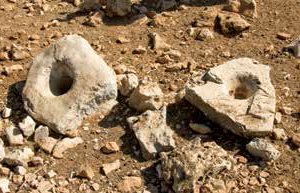
Socket Stones
Gate Socket Stones at Kh. el-Maqatir (Answers in Genesis)
Infant burial jar found at Kh. el-Maqatir (Biblearchaeology.org)
      • Infant burial jar found at Kh. el-Maqatir affirms that both men and women were living there.
      • Kh. el-Maqatir remained a desolate ruin after destruction by fire in the time of Joshua.
      • This site fits the Joshua account well. The mountain between Ai and Bethel noted in Genesis may be explained by an earlier Ai ("Getting Archaeology Right at Ai", Footnote 2) being located at et-Tell. This would leave the sites of either Baytin/Beitin or Kh. el-Maqatir as the mountain Abram stood on with Ai on the east and Bethel on the west.


Saturday, February 20, 2016

Adam&Eve--In light of present-day facts

We have no ability to interrogate a first-hand witness. So, the next alternative must be examination of present-day facts. How believable is the Genesis account of Adam and Eve in view of "modern" knowledge?

Some facts/customs/widespread beliefs compared to Scripture:
  • Basis for clothing only worn by mankind
    • This fact is readily known. Animals may have fur and/or feathers, but they do not go to the trouble to make clothing for themselves.
    • Genesis 3:6-7, "When the woman saw that the tree was good for food, and that it was a delight to the eyes, and that the tree was desirable to make one wise, she took from its fruit and ate; and she gave also to her husband with her, and he ate. Then the eyes of both of them were opened, and they knew that they were naked; and they sewed fig leaves together and made themselves loin coverings."
  • Basis for observance of the week
    • The week is not only clearly present in the US calendar, but is also recognized by the International Organization for Standardization (ISO).
    • Genesis 2:1-3, "Thus the heavens and the earth were completed, and all their hosts. By the seventh day God completed His work which He had done, and He rested on the seventh day from all His work which He had done. Then God blessed the seventh day and sanctified it, because in it He rested from all His work which God had created and made."--How would billions of years of evolution yield this observance?
  • Basis for long, painful labor in childbirth only seen in mankind
    • This is recognized by even scientists.
    • Genesis 3:11-16, "And He said, 'Who told you that you were naked? Have you eaten from the tree of which I commanded you not to eat?' . . . "To the woman He said,
                  'I will greatly multiply
                  Your pain in childbirth,
                  In pain you will bring forth children;
                  Yet your desire will be for your husband,
                  And he will rule over you.'"
  • Basis for human agriculture/toiling over the ground to raise crops
    • Setting aside the cases of certain termites, ants, and ambrosia beetles, this practice is not seen among the claimed close evolutionary ancestors of man.
    • Genesis 3:17-19, "Then to Adam He said, 'Because you have listened to the voice of your wife, and have eaten from the tree about which I commanded you, saying, "You shall not eat from it";
                  Cursed is the ground because of you;
                  In toil you will eat of it
                  All the days of your life.

            Both thorns and thistles it shall grow for you;
                  And you will eat the plants of the field;

            By the sweat of your face
                  You will eat bread,
                  Till you return to the ground,
                  Because from it you were taken;
                  For you are dust,
                  And to dust you shall return.'"
  • Basis for man's unique moral awareness
    •  Recognized by Darwin and now within modern psychology
    •  Genesis 3:5-6, "'For God knows that in the day you eat from it your eyes will be opened, and you will be like God, knowing good and evil.' When the woman saw that the tree was good for food, and that it was a delight to the eyes, and that the tree was desirable to make one wise, she took from its fruit and ate; and she gave also to her husband with her, and he ate."
  • Basis for man's unique intelligence
    • Globally apparent from mankind's unrivaled achievements: space exploration as Earth dwellers, deep-sea exploration as land-dwellers, nanotechnology, computers, cars, sky-scrapers, instant long-distance communication, etc.
    • Genesis 1:26, "Then God said, 'Let Us make man in Our image, according to Our likeness; and let them rule over the fish of the sea and over the birds of the sky and over the cattle and over all the earth, and over every creeping thing that creeps on the earth.'"
  • Basis for belief in a Supernatural Being
    • There is a significant percentage of people worldwide who believe in God.
    • Genesis 3:8, "They heard the sound of the LORD God walking in the garden in the cool of the day, and the man and his wife hid themselves from the presence of the LORD God among the trees of the garden."
  • Basis for discipline/punishment
    • The practice of discipline or punishment is clear through worldwide child discipline, police, governmental courts, and prisons or correctional facilities.
    • Genesis 3:22-23, "Then the LORD God said, 'Behold, the man has become like one of Us, knowing good and evil; and now, he might stretch out his hand, and take also from the tree of life, and eat, and live forever'— therefore the LORD God sent him out from the garden of Eden, to cultivate the ground from which he was taken."
  • Basis for mankind's dominion over the Earth
    • Clear from the existence of zoos, agriculture, industrialization, rapid transportation, etc.
    • Genesis 1:27-28, "God created man in His own image, in the image of God He created him; male and female He created them. God blessed them; and God said to them, 'Be fruitful and multiply, and fill the earth, and subdue it; and rule over the fish of the sea and over the birds of the sky and over every living thing that moves on the earth.'"
  • Basis for family household of a man and woman, providing care for any young children.
    • Shown in research by the Organization for Economic Co-operation and Development (OECD)
    • Genesis 2:22-24, "The LORD God fashioned into a woman the rib which He had taken from the man, and brought her to the man. The man said,
                  'This is now bone of my bones,
                  And flesh of my flesh;
                  She shall be called Woman,
                  Because she was taken out of Man.'

      For this reason a man shall leave his father and his mother, and be joined to his wife; and they shall become one flesh."
  • Beginning of marital conflict/heartache/divorce
    • A widely enough known problem to stimulate much research. Some 2010 research.
    • Genesis 3:11-13, "And He said, 'Who told you that you were naked? Have you eaten from the tree of which I commanded you not to eat?' The man said, 'The woman whom You gave to be with me, she gave me from the tree, and I ate.' Then the LORD God said to the woman, 'What is this you have done?' And the woman said, 'The serpent deceived me, and I ate.'"
  • Basis for lifelong marriage
    • Recognized by US census (see page 4).
    • Genesis 2:22-24, seen above under family household
  • Basis for racial equality
    • What the American Civil War/War between the States was fought over.
    • Genesis 3:20, "Now the man called his wife’s name Eve, because she was the mother of all the living."
  • Basis for value of women/a two-gender humanity rather than a single-gender
    • Recognized so strongly today that this is a political pitfall for those who don't choose their words carefully.
    • Genesis 2:18, "Then the LORD God said, “It is not good [emphasis added] for the man to be alone; I will make him a helper suitable for him.”
 

Sunday, February 14, 2016

"Names, names . . . come now, you can find legends in any culture."

How do you know what is legend and what is truth? Is truth not known by first-hand witness, trustworthy reports, or present-day fact? So how does one search out the truth in a list of names? Surely finding out the truth of a matter requires being willing to do a little research--going back to those primary sources, as students and researchers are encouraged to do in writing good papers.

So, the first primary source, in this case, would be the document making the claim/putting forward genealogical list (i.e. Scripture).

How does Adam figure in the rest of Scripture (outside of Genesis, I Chronicles, and Luke)?
  • Hosea 6:4-7, "'What shall I do with you, O Ephraim?
                What shall I do with you, O Judah?
                For your loyalty is like a morning cloud
                And like the dew which goes away early.
          Therefore I have hewn them in pieces by the prophets;
                I have slain them by the words of My mouth;
                And the judgments on you are like the light that goes forth.
          For I delight in loyalty rather than sacrifice,
                And in the knowledge of God rather than burnt offerings.
          But like Adam they have transgressed the covenant;
                There they have dealt treacherously against Me.'"

    • Ephraim - One of Joseph's sons, a tribe of Israel, and one of the tribes identified with the Northern Kingdom of Israel (conquered by the Assyrians).
    • Judah - One of Israel/Jacob's sons, a tribe of Israel, and first tribe associated with the Southern Kingdom (conquered by the Babylonians), later joined by the tribe of Benjamin.
    • Adam - In context, a historical figure against whom the historical tribe of Ephraim/the Northern Kingdom and the historical tribe of Judah/the Southern Kingdom could be compared.
  • I Timothy 2:12-15, "But I do not allow a woman to teach or exercise authority over a man, but to remain quiet. For it was Adam who was first created, and then Eve. And it was not Adam who was deceived, but the woman being deceived, fell into transgression. But women will be preserved through the bearing of children if they continue in faith and love and sanctity with self-restraint."
    • I realize this is a controversial passage, both within and without Christian circles. But surely I cannot be accused of bigotry against women, as a woman myself, who is pursuing a Ph.D. in Materials Science & Engineering. Why would I be my own antagonist?
    • Adam - Apparently a historical figure, alongside Eve, since historical New Testament Christian men and women are compared to them. Would men and women truly be compared to and be held accountable for the imaginative deeds of imaginative ancestors?
    • Creation of mankind is given in the same sequence as in Genesis--first Adam, and then Eve.
    • Again, as in Genesis, Eve was the one deceived (by the serpent).
  • Jude 1:14, "It was also about these men that Enoch, in the seventh generation from Adam, prophesied, saying, 'Behold, the Lord came with many thousands of His holy ones, to execute judgment upon all, and to convict all the ungodly of all their ungodly deeds which they have done in an ungodly way, and of all the harsh things which ungodly sinners have spoken against Him.'"
    • Adam - Apparently a historical figure, as he was named the forefather of one who foretold of coming events. It would be self-defeating to say that imaginary characters were given Word from God which was "later" fulfilled in the time of real New Testament Christians.
    • As in Genesis, Adam is identified with the starting point generation, while Enoch is identified with the 7th generation.
  • I Corinthians 15:42-47, "So also is the resurrection of the dead. It is sown a perishable body, it is raised an imperishable body; it is sown in dishonor, it is raised in glory; it is sown in weakness, it is raised in power; it is sown a natural body, it is raised a spiritual body. If there is a natural body, there is also a spiritual body. So also it is written, 'The first MAN, Adam, BECAME A LIVING SOUL.' The last Adam became a life-giving spirit. However, the spiritual is not first, but the natural; then the spiritual. The first man is from the earth, earthy; the second man is from heaven."
    • Adam - Understanding the larger context of I Corinthians, the first Adam is referring to Adam in the Garden of Eden, while the last Adam refers to Christ. Apparently, the first Adam was an earthly, historical, living person, just as much as Christ, the 2nd Adam, was the Son of God from heaven. 
    • The first Adam set the example of what it means to have an earthly body.
  • Romans 5:12-15, "Therefore, just as through one man sin entered into the world, and death through sin, and so death spread to all men, because all sinned— for until the Law sin was in the world, but sin is not imputed when there is no law. Nevertheless death reigned from Adam until Moses, even over those who had not sinned in the likeness of the offense of Adam, who is a type of Him who was to come. But the free gift is not like the transgression. For if by the transgression of the one the many died, much more did the grace of God and the gift by the grace of the one Man, Jesus Christ, abound to the many."
    • Adam - Apparently a historical figure, as Christ's counterpart--noted for bringing death and sin into the world, unlike Christ who brought life and righteousness.
    • Just as Christ acted as representative for mankind in the form of a historical man, so Adam in the Garden of Eden could only have acted as representative for mankind as a historical man.
 

Saturday, February 6, 2016

Ancestry.Bible

Passing over "The Fall" and Cain and Abel, one comes to Genesis 5:
Genesis 5:1-5, "This is the book of the generations of Adam. In the day when God created man, He made him in the likeness of God. He created them male and female, and He blessed them and named them Man in the day when they were created. When Adam had lived one hundred and thirty years, he became the father of a son in his own likeness, according to his image, and named him Seth. Then the days of Adam after he became the father of Seth were eight hundred years, and he had other sons and daughters. So all the days that Adam lived were nine hundred and thirty years, and he died."

Tracing one ancestral line, you find the following names:
Adam - Seth - Enosh - Kenan - Mahalalel - Jared - Enoch - Methuselah - Lamech - Noah - Shem
Transition to Genesis 10:
Noah - Shem - Arpachshad - Shelah - Eber - Peleg - Reu - Serug - Nahor - Terah - Abram (Abraham)
Transition to I Chronicles 1-3:
Abraham - Isaac - Israel (Jacob) - Judah - Perez - Hezron - Ram - Amminadab - Nahshon - Salma - Boaz - Obed - Jesse - David - Nathan
----

Compare in reverse to Luke 3:
(Jesus) - Joseph - Eli - Matthat - Levi - Melchi - Jannai - Joseph - Mattathias - Amos - Nahum - Hesli - Naggai - Maath - Mattathias - Semein - Josech - Joda - Joanan - Rhesa - Zerubbabel - Shealtiel - Neri - Melchi - Addi - Cosam - Elmadam - Er - Joshua - Eliezer - Jorim - Matthat - Levi - Simeon - Judah - Joseph - Jonam - Eliakim - Melea - Menna - Mattatha -
Nathan - David - Jesse - Obed - Boaz - Salmon - Nahshon - Amminadab - Admin - Ram - Hezron - Perez - Judah - Jacob - Isaac - Abraham - Terah - Nahor - Serug - Reu - Peleg - Heber - Shelah - Cainan - Arphaxad - Shem - Noah - Lamech - Methuselah - Enoch - Jared - Mahalaleel - Cainan - Enosh - Seth - Adam, "the son of God".

Black Obelisk of Shalmaneser III

Some Supporting Archaeology & Historical Records: