Isaiah 40:6-8 (NASB)

Isaiah 40:6-8 (NASB)

6) A voice says, “Call out.”
Then he answered, “What shall I call out?”
All flesh is grass, and all its loveliness is like the flower of the field.

7) The grass withers, the flower fades,
When the breath of the LORD blows upon it;
Surely the people are grass.

8) The grass withers, the flower fades,
But the word of our God stands forever.

Friday, March 25, 2016

Why would a man be given a new name?

The Old Testament genealogies continue to stretch onward. The next well known name in the list is that of Abram, or Abraham. In order to begin research into his background, I'll again start with the primary source, the Biblical account. This starts in Genesis 11:26, but I will skip a few verses to Genesis 12:1-9:
Now the LORD said to Abram,
            “Go forth from your country,
            And from your relatives
            And from your father’s house,
            To the land which I will show you;

And I will make you a great nation,
            And I will bless you,
            And make your name great;
            And so you shall be a blessing;

And I will bless those who bless you,
            And the one who curses you I will curse.
            And in you all the families of the earth will be blessed.”

So Abram went forth as the LORD had spoken to him; and Lot went with him. Now Abram was seventy-five years old when he departed from Haran. Abram took Sarai his wife and Lot his nephew, and all their possessions which they had accumulated, and the persons which they had acquired in Haran, and they set out for the land of Canaan; thus they came to the land of Canaan. Abram passed through the land as far as the site of Shechem, to the oak of Moreh. Now the Canaanite was then in the land. The LORD appeared to Abram and said, “To your descendants I will give this land.” So he built an altar there to the LORD who had appeared to him. Then he proceeded from there to the mountain on the east of Bethel, and pitched his tent, with Bethel on the west and Ai on the east; and there he built an altar to the LORD and called upon the name of the LORD. Abram journeyed on, continuing toward the Negev.
Transition to Genesis 17:1-5:
Now when Abram was ninety-nine years old, the LORD appeared to Abram and said to him,
          "I am God Almighty;
          Walk before Me, and be blameless.

I will establish My covenant between Me and you,
            And I will multiply you exceedingly."

Abram fell on his face, and God talked with him, saying,
"As for Me, behold, My covenant is with you,
            And you will be the father of a multitude of nations.

No longer shall your name be called Abram,
            But your name shall be Abraham;
            For I have made you the father of a multitude of nations."


But the name of Abraham is not confined to Genesis alone. Other books in the Old Testament name him (the following instances are not exhaustive, and this does not include the New Testament yet). There is no mistake about the name being belonging to one with a different story:
  • Exodus 2:23-24, "Now it came about in the course of those many days that the king of Egypt died. And the sons of Israel sighed because of the bondage, and they cried out; and their cry for help because of their bondage rose up to God. So God heard their groaning; and God remembered His covenant with Abraham, Isaac, and Jacob."
    • Abraham - portrayed as a historical man.
    • Why would God remember a covenant with a man who never lived?
    • Why would God relate a detailed covenant of blessing and land (Genesis 12:1-9) to a man who never lived?
    • Abraham, Isaac, and Jacob--this list of names is replicated numerous times in the Old Testament, indicating that the names must have been rather important to the Israelite people, and to God in speaking with the nation.
    • Why would God hearing the groanings of Israel under bondage have anything to do with men (Abraham, Isaac, and Jacob) who never lived?
  • Exodus 3:3-6, "So Moses said, 'I must turn aside now and see this marvelous sight, why the bush is not burned up.' When the LORD saw that he turned aside to look, God called to him from the midst of the bush and said, 'Moses, Moses!' And he said, 'Here I am.' Then He said, 'Do not come near here; remove your sandals from your feet, for the place on which you are standing is holy ground.' He said also, 'I am the God of your father, the God of Abraham, the God of Isaac, and the God of Jacob.' Then Moses hid his face, for he was afraid to look at God."
    • Abraham - portrayed as a historical man.
    • God identifies Himself as both the God of Moses' own father, and the God of Abraham.
    • How could the father of someone be paralleled with a man who never lived?
    • Why would Moses fear if God was identifying himself as the God of imaginary people? Who would fear the lord of an imaginary world?
    • Abraham, Isaac, and Jacob--again the same genealogical list. 
  • Exodus 6:1-5, "Then the LORD said to Moses, 'Now you shall see what I will do to Pharaoh; for under compulsion he will let them go, and under compulsion he will drive them out of his land.' God spoke further to Moses and said to him, 'I am the LORD; and I appeared to Abraham, Isaac, and Jacob, as God Almighty, but by My name, LORD, I did not make Myself known to them. I also established My covenant with them, to give them the land of Canaan, the land in which they sojourned. Furthermore I have heard the groaning of the sons of Israel, because the Egyptians are holding them in bondage, and I have remembered My covenant.'"
    • Abraham - portrayed as a historical man.
    • Why would God say He had appeared to imaginary individuals as Almighty God through their imaginary lives?
    • Abraham, Isaac, and Jacob--again the same genealogical list.
    • Why would God Himself reference the sojournings of Abraham, Isaac, and Jacob when these stories were imaginary?
    • Why would God Himself say that He made a covenant with imaginary people?
  • Deuteronomy 1:6-8, "'The LORD our God spoke to us at Horeb, saying, "You have stayed long enough at this mountain. Turn and set your journey, and go to the hill country of the Amorites, and to all their neighbors in the Arabah, in the hill country and in the lowland and in the Negev and by the seacoast, the land of the Canaanites, and Lebanon, as far as the great river, the river Euphrates. See, I have placed the land before you; go in and possess the land which the LORD swore to give to your fathers, to Abraham, to Isaac, and to Jacob, to them and their descendants after them."'"
    • Abraham - portrayed as a historical man.
    • Why would God map out a land promised in an imaginary covenant/with imaginary people?
    • Abraham, Isaac, and Jacob--again the same genealogical list. 
    • Why would the nation of Israel be identified as the descendants of imaginary men?
    • How could the sons of Israel possibly be motivated to go and conquer a land promised to them merely through men whom they knew to be fictitious?
    • How could the nation of Israel really look upon a land promised to imaginary individuals?
  • Deuteronomy 9:25-29, "'So I fell down before the LORD the forty days and nights, which I did because the LORD had said He would destroy you. I prayed to the LORD and said, "O Lord GOD, do not destroy Your people, even Your inheritance, whom You have redeemed through Your greatness, whom You have brought out of Egypt with a mighty hand. Remember Your servants, Abraham, Isaac, and Jacob; do not look at the stubbornness of this people or at their wickedness or their sin. Otherwise the land from which You brought us may say, 'Because the LORD was not able to bring them into the land which He had promised them and because He hated them He has brought them out to slay them in the wilderness.' Yet they are Your people, even Your inheritance, whom You have brought out by Your great power and Your outstretched arm."'"
    • Abraham - portrayed as a historical man.
    • Why would Moses, the current leader of Israel, plead with God turn aside His wrath by remembering imaginary individuals? How could this possibly be a persuasive argument on Moses' part?
    • Abraham, Isaac, and Jacob--again the same genealogical list. 
    • Why would Israel be considered God's people, if so rebellious, unless the stories about Abraham, Isaac, and Jacob were real?
    • Why would the land of Canaan/the Canaanites be likely to mock that God was unable to fulfill promises He never made, or made merely to imaginary people?


Sunday, March 13, 2016

Noah--Looking back . . . (Part II)

Resuming exploration of the Biblical Flood in terms of present-day facts and beliefs:
  • Subterranean water
    • Trapped water - Potentially three times more water in the mineral ringwoodite, 400 miles below Earth's surface, than in surface oceans.
    • Aquifers - Supplying ~70% (or more) of fresh water for irrigation and drinking.
    • Genesis 7:11, 7:19, 8:3, 8:14, "In the six hundredth year of Noah’s life, in the second month, on the seventeenth day of the month, on the same day all the fountains of the great deep burst open, and the floodgates of the sky were opened . . . The water prevailed more and more upon the earth, so that all the high mountains everywhere under the heavens were covered . . . and the water receded steadily from the earth, and at the end of one hundred and fifty days the water decreased . . . In the second month, on the twenty-seventh day of the month, the earth was dry."
  • Geysers, showing the reality of forceful expulsion of water from subterranean regions
    • Hardly requires a specific source. Here is a Wikipedia list, where most are located in the United States or New Zealand.
    • Genesis 7:11, "In the six hundredth year of Noah’s life, in the second month, on the seventeenth day of the month, on the same day all the fountains of the great deep burst open, and the floodgates of the sky were opened."
  • Worldwide, water-deposited sedimentary rocks
    • Limestone: Formed by precipitation of calcite from water or by deposition of marine organisms.
    • Limestone: Composes ~15% of sedimentary rock in the Earth's crust.
    • Oil & Gas Shale (a.k.a. "mudstone"): Found in 46 countries, including vast landlocked regions, as shown in the linked EIA map.
    • Genesis 7:17-19, "Then the flood came upon the earth for forty days, and the water increased and lifted up the ark, so that it rose above the earth. The water prevailed and increased greatly upon the earth, and the ark floated on the surface of the water. The water prevailed more and more upon the earth, so that all the high mountains everywhere under the heavens were covered."
  • Un-ending summer, winter, planting, and harvest
    • The regularity of seasons is confirmed by the global success of agriculture (talking in general here, not denying localized floods and hurricanes).
    • Abnormal seasons are still newsworthy/noteworthy, not commonplace. One example was "The Year Without a Summer", which was still marked by rain rather than snow.
    • Genesis 8:20-22, "Then Noah built an altar to the LORD, and took of every clean animal and of every clean bird and offered burnt offerings on the altar. The LORD smelled the soothing aroma; and the LORD said to Himself, 'I will never again curse the ground on account of man, for the intent of man’s heart is evil from his youth; and I will never again destroy every living thing, as I have done. While the earth remains,
                  Seedtime and harvest,
                  And cold and heat,
                  And summer and winter,
                  And day and night
                  Shall not cease.'"
  • Mankind filling the earth
    • This requires no specific source.
    • Genesis 9:1, "And God blessed Noah and his sons and said to them, 'Be fruitful and multiply, and fill the earth.'"
  • Animals' fear of man
    • Seen by anyone who tries to walk up to a deer or a bird in the wild. An animal has to be domesticated to subdue this fear.
    • Genesis 9:2, "'The fear of you and the terror of you will be on every beast of the earth and on every bird of the sky; with everything that creeps on the ground, and all the fish of the sea, into your hand they are given.'"
  • Distastefulness of eating live meat (of animals with blood circulation systems)--(Edited 3/14/2016)
    • Generally accepted, with exceptions mainly just dishes prepared for sensational effect.
    • Genesis 9:3-4, "'Every moving thing that is alive shall be food for you; I give all to you, as I gave the green plant. Only you shall not eat flesh with its life, that is, its blood.'"
  • Retribution of death to murderers
    • This may require a specific source today, although not in the past. About 55 countries, according to Death Penalty Worldwide, still consider murder to be punishable by death.
    • Genesis 9:6-7, "'Whoever sheds man’s blood,
                  By man his blood shall be shed,
                  For in the image of God
                  He made man.

            As for you, be fruitful and multiply;
                  Populate the earth abundantly and multiply in it.'"


Saturday, March 5, 2016

Noah--Looking back from today (Part I).

This subject is difficult. Talking about a worldwide flood sounds very strange. Many people can accept the idea of mankind descending from two earlier human ancestors--although there's disagreement where those ancestors came from. But when you raise the idea of a global flood you find yourself patted on the shoulder as a believer in myths:
While some scholars have offered possible explanations for the origins of the flood myth including a legendary retelling of a possible Black Sea deluge, the general mythological exaggeration and implausibility of the story are widely recognized by relevant academic fields. The acknowledgement of this follows closely the development of understanding of the natural history and especially the geology and paleontology of the planet ("Genesis flood narrative." Wikipedia.).
 I will grant that a global flood is not something anyone living has seen.

How Did Fish Survive Noah’s Flood?
"The Flood?" Answers in Genesis. 2016. Web. March 5, 2016.


With no one living to tell the tale, I'll turn again to present-day facts and widespread beliefs:
  • No worldwide flood in modern, accepted history
    • This requires no specific sources.
    • Genesis 9:11, "'I establish My covenant with you; and all flesh shall never again be cut off by the water of the flood, neither shall there again be a flood to destroy the earth.'"
  • The rainbow, broadly visible to both man and beast following rainstorms
    •  This requires no specific sources.
    • Genesis 9:12-15, "God said, 'This is the sign of the covenant which I am making between Me and you and every living creature that is with you, for all successive generations; I set My bow in the cloud, and it shall be for a sign of a covenant between Me and the earth. It shall come about, when I bring a cloud over the earth, that the bow will be seen in the cloud, and I will remember My covenant, which is between Me and you and every living creature of all flesh; and never again shall the water become a flood to destroy all flesh.'"
  • Giants (i.e. very tall people, often of great strength, some with more than the normal number of toes/fingers)
    • Robert Wadlow, native of Illinois, reached 8 ft 11.1 in.
    • Anna Swan, Canadian, reached 7 ft 6 in.
    • Pranamya Menaria and Devendra Harne, Indian, having 25 total fingers & toes.
    • Andre the Giant (a.k.a. the giant "Fezzik" in The Princess Bride movie), French, was a wrestler and reached 7 ft 4 in.
    • Jorge Gonzales, Argentinian, was the tallest World Wrestling Federation member, reaching 7 ft 7in.
    • Genesis 6:4, "The Nephilim were on the earth in those days, and also afterward, when the sons of God came in to the daughters of men, and they bore children to them. Those were the mighty men who were of old, men of renown."
    • Numbers 13:32-33, "So they gave out to the sons of Israel a bad report of the land which they had spied out, saying, 'The land through which we have gone, in spying it out, is a land that devours its inhabitants; and all the people whom we saw in it are men of great size. There also we saw the Nephilim (the sons of Anak are part of the Nephilim); and we became like grasshoppers in our own sight, and so we were in their sight.'"
    • II Samuel 21:20-21, "There was war at Gath again, where there was a man of great stature who had six fingers on each hand and six toes on each foot, twenty-four in number; and he also had been born to the giant. When he defied Israel, Jonathan the son of Shimei, David’s brother, struck him down."
  • Multicultural accounts of a great flood similar to Noah's
    • Escape in an ark/chest:
    • Flood covering the mountains:
    • Survival of only a few people and pairs of animals:
    • Sending out a bird/animal to discover if the waters had subsided:
    • Genesis 7:13-20, "On the very same day Noah and Shem and Ham and Japheth, the sons of Noah, and Noah’s wife and the three wives of his sons with them, entered the ark, they and every beast after its kind, and all the cattle after their kind, and every creeping thing that creeps on the earth after its kind, and every bird after its kind, all sorts of birds. So they went into the ark to Noah, by twos of all flesh in which was the breath of life. Those that entered, male and female of all flesh, entered as God had commanded him; and the LORD closed it behind him. Then the flood came upon the earth for forty days, and the water increased and lifted up the ark, so that it rose above the earth. The water prevailed and increased greatly upon the earth, and the ark floated on the surface of the water. The water prevailed more and more upon the earth, so that all the high mountains everywhere under the heavens were covered. The water prevailed fifteen cubits higher, and the mountains were covered."
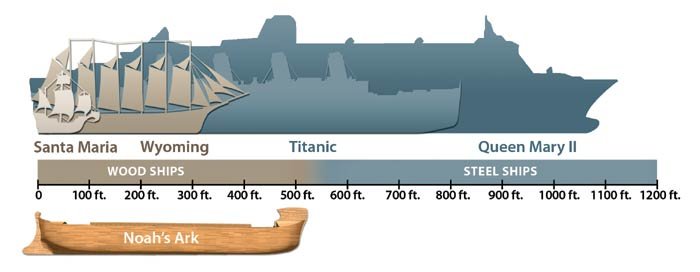
  • Ability of ancients to build large boats
Ship size comparison
"How large was Noah's Ark?" Answers in Genesis. 2016. Web. March 5, 2016.
    • The Leontifera and a 420 ft long later model
    • Chinese junks over 400 ft long
    • Egyptian ship made of cedar around 450 ft long
    • Genesis 6:14-16, "'Make for yourself an ark of gopher wood; you shall make the ark with rooms, and shall cover it inside and out with pitch. This is how you shall make it: the length of the ark three hundred cubits, its breadth fifty cubits, and its height thirty cubits. You shall make a window for the ark, and finish it to a cubit from the top; and set the door of the ark in the side of it; you shall make it with lower, second, and third decks.'"
Conservatively, if 1 cubit = ~1.5 ft (from fingertip to elbow of a man's arm):
      • Length = 300 cubits = ~450 ft
      • Breadth = 50 cubits = ~75 ft
      • Height = 30 cubits = ~45 ft
  • Worldwide fossil beds
    • Essentially no need for a specific source. Here is one general reference.
    • Genesis 6:17, "'Behold, I, even I am bringing the flood of water upon the earth, to destroy all flesh in which is the breath of life, from under heaven; everything that is on the earth shall perish.'"
But specimens where no phosphate could be seen still yielded small pieces of phosphatized soft tissue.Tissue types so far recovered include muscle fibres with banding present (Fig.6). Some muscle fibres display ultrastructure and show fibrils and even cell nuclei arranged in neat rows (Fig.7). Underneath the scales small pieces of dermis (skin) are preserved and show thin sheets of muscle and connective tissue. A female Notelops had ovaries with developing eggs inside, and one egg even had phosphatized yolk.
Martill, David M. "The Medusa effect: instantaneous fossilization." Geology Today (1989): 203. Web. Feb. 5, 2016. 
    • 80-day mineralization of plants: "Understanding fossilization: Experimental pyritization of plants"
    • Genesis 7:11-8:5, "In the six hundredth year of Noah’s life, in the second month, on the seventeenth day of the month, on the same day all the fountains of the great deep burst open, and the floodgates of the sky were opened. The rain fell upon the earth for forty days and forty nights . . . Then the flood came upon the earth for forty days, and the water increased and lifted up the ark, so that it rose above the earth . . . In the seventh month, on the seventeenth day of the month, the ark rested upon the mountains of Ararat. The water decreased steadily until the tenth month; in the tenth month, on the first day of the month, the tops of the mountains became visible."
 

Saturday, February 27, 2016

Grace, for one man's sake.

 
"Who Am I" by Casting Crowns


Genesis 6:5-19, "Then the LORD saw that the wickedness of man was great on the earth, and that every intent of the thoughts of his heart was only evil continually. The LORD was sorry that He had made man on the earth, and He was grieved in His heart. The LORD said, 'I will blot out man whom I have created from the face of the land, from man to animals to creeping things and to birds of the sky; for I am sorry that I have made them.' But Noah found favor in the eyes of the LORD . . . 'Behold, I, even I am bringing the flood of water upon the earth, to destroy all flesh in which is the breath of life, from under heaven; everything that is on the earth shall perish. But I will establish My covenant with you; and you shall enter the ark—you and your sons and your wife, and your sons’ wives with you. And of every living thing of all flesh, you shall bring two of every kind into the ark, to keep them alive with you; they shall be male and female.'"


Identity of Noah in Scripture:
  • Isaiah 54:9-10, “'For this is like the days of Noah to Me,
                When I swore that the waters of Noah
                Would not flood the earth again;
                So I have sworn that I will not be angry with you
                Nor will I rebuke you.
     
  •      'For the mountains may be removed and the hills may shake,
                But My lovingkindness will not be removed from you,
                And My covenant of peace will not be shaken,'
                Says the LORD who has compassion on you."

    • Noah: Portrayed as a historical man. Why would God swear to not flood the earth again in a similar manner to a flood that never happened?
    • As surely as God has established a covenant of peace, so surely must He have also established a covenant to never again flood the whole earth (after just such an event).
  • Ezekiel 14:12-16, "Then the word of the LORD came to me saying, 'Son of man, if a country sins against Me by committing unfaithfulness, and I stretch out My hand against it, destroy its supply of bread, send famine against it and cut off from it both man and beast, even though these three men, Noah, Daniel and Job were in its midst, by their own righteousness they could only deliver themselves,' declares the Lord GOD. 'If I were to cause wild beasts to pass through the land and they depopulated it, and it became desolate so that no one would pass through it because of the beasts, though these three men were in its midst, as I live,' declares the Lord GOD, 'they could not deliver either their sons or their daughters. They alone would be delivered, but the country would be desolate.'"
    • Noah: Portrayed as a historical man. How could imaginative individuals have the righteousness to deliver themselves from real judgment?
    • It is needlessly confusing to say Noah's children were saved in the original imaginative story of Noah, whereas they would not be saved in the real context of the faithless nation of Israel.
  • Hebrews 11:1-7, "Now faith is the assurance of things hoped for, the conviction of things not seen. For by it the men of old gained approval. By faith we understand that the worlds were prepared by the word of God, so that what is seen was not made out of things which are visible . . . By faith Enoch was taken up so that he would not see death; AND HE WAS NOT FOUND BECAUSE GOD TOOK HIM UP; for he obtained the witness that before his being taken up he was pleasing to God. And without faith it is impossible to please Him, for he who comes to God must believe that He is and that He is a rewarder of those who seek Him. By faith Noah, being warned by God about things not yet seen, in reverence prepared an ark for the salvation of his household, by which he condemned the world, and became an heir of the righteousness which is according to faith."
    • Noah: Portrayed as a historical man. Does God really warn imaginative individuals of future judgment?
    • Just as real, New Testament Christians are approved by faith, so also must a real man Noah have set an example of being approved by faith.
  • I Peter 3:18-20, "For Christ also died for sins once for all, the just for the unjust, so that He might bring us to God, having been put to death in the flesh, but made alive in the spirit; in which also He went and made proclamation to the spirits now in prison, who once were disobedient, when the patience of God kept waiting in the days of Noah, during the construction of the ark, in which a few, that is, eight persons, were brought safely through the water."
    • Noah: Portrayed as a historical man. How do you say that a real God was patient during an imaginative story?
    • How could Christ have made a proclamation to spirits of men said to die in an imaginative story?
    • Only eight people survived this flood in the time of Noah--indicating it was very large-scale.
  • II Peter 2:4-10, "For if God did not spare angels when they sinned, but cast them into hell and committed them to pits of darkness, reserved for judgment; and did not spare the ancient world, but preserved Noah, a preacher of righteousness, with seven others, when He brought a flood upon the world of the ungodly; and if He condemned the cities of Sodom and Gomorrah to destruction by reducing them to ashes, having made them an example to those who would live ungodly lives thereafter . . . then the Lord knows how to rescue the godly from temptation, and to keep the unrighteous under punishment for the day of judgment, and especially those who indulge the flesh in its corrupt desires and despise authority."
    • Noah: Portrayed as a historical man. Just as fallen angels have been committed to judgment, so also all the ancient world, excepting only Noah and his seven family members, were judged by God.
    • Believing that "the Lord knows how to rescue" Christians from temptation is said to be just as sure as saying that a real man Noah, and his family, were rescued from the ungodliness of the ancient world.


Saturday, February 20, 2016

Adam&Eve--In light of present-day facts

We have no ability to interrogate a first-hand witness. So, the next alternative must be examination of present-day facts. How believable is the Genesis account of Adam and Eve in view of "modern" knowledge?

Some facts/customs/widespread beliefs compared to Scripture:
  • Basis for clothing only worn by mankind
    • This fact is readily known. Animals may have fur and/or feathers, but they do not go to the trouble to make clothing for themselves.
    • Genesis 3:6-7, "When the woman saw that the tree was good for food, and that it was a delight to the eyes, and that the tree was desirable to make one wise, she took from its fruit and ate; and she gave also to her husband with her, and he ate. Then the eyes of both of them were opened, and they knew that they were naked; and they sewed fig leaves together and made themselves loin coverings."
  • Basis for observance of the week
    • The week is not only clearly present in the US calendar, but is also recognized by the International Organization for Standardization (ISO).
    • Genesis 2:1-3, "Thus the heavens and the earth were completed, and all their hosts. By the seventh day God completed His work which He had done, and He rested on the seventh day from all His work which He had done. Then God blessed the seventh day and sanctified it, because in it He rested from all His work which God had created and made."--How would billions of years of evolution yield this observance?
  • Basis for long, painful labor in childbirth only seen in mankind
    • This is recognized by even scientists.
    • Genesis 3:11-16, "And He said, 'Who told you that you were naked? Have you eaten from the tree of which I commanded you not to eat?' . . . "To the woman He said,
                  'I will greatly multiply
                  Your pain in childbirth,
                  In pain you will bring forth children;
                  Yet your desire will be for your husband,
                  And he will rule over you.'"
  • Basis for human agriculture/toiling over the ground to raise crops
    • Setting aside the cases of certain termites, ants, and ambrosia beetles, this practice is not seen among the claimed close evolutionary ancestors of man.
    • Genesis 3:17-19, "Then to Adam He said, 'Because you have listened to the voice of your wife, and have eaten from the tree about which I commanded you, saying, "You shall not eat from it";
                  Cursed is the ground because of you;
                  In toil you will eat of it
                  All the days of your life.

            Both thorns and thistles it shall grow for you;
                  And you will eat the plants of the field;

            By the sweat of your face
                  You will eat bread,
                  Till you return to the ground,
                  Because from it you were taken;
                  For you are dust,
                  And to dust you shall return.'"
  • Basis for man's unique moral awareness
    •  Recognized by Darwin and now within modern psychology
    •  Genesis 3:5-6, "'For God knows that in the day you eat from it your eyes will be opened, and you will be like God, knowing good and evil.' When the woman saw that the tree was good for food, and that it was a delight to the eyes, and that the tree was desirable to make one wise, she took from its fruit and ate; and she gave also to her husband with her, and he ate."
  • Basis for man's unique intelligence
    • Globally apparent from mankind's unrivaled achievements: space exploration as Earth dwellers, deep-sea exploration as land-dwellers, nanotechnology, computers, cars, sky-scrapers, instant long-distance communication, etc.
    • Genesis 1:26, "Then God said, 'Let Us make man in Our image, according to Our likeness; and let them rule over the fish of the sea and over the birds of the sky and over the cattle and over all the earth, and over every creeping thing that creeps on the earth.'"
  • Basis for belief in a Supernatural Being
    • There is a significant percentage of people worldwide who believe in God.
    • Genesis 3:8, "They heard the sound of the LORD God walking in the garden in the cool of the day, and the man and his wife hid themselves from the presence of the LORD God among the trees of the garden."
  • Basis for discipline/punishment
    • The practice of discipline or punishment is clear through worldwide child discipline, police, governmental courts, and prisons or correctional facilities.
    • Genesis 3:22-23, "Then the LORD God said, 'Behold, the man has become like one of Us, knowing good and evil; and now, he might stretch out his hand, and take also from the tree of life, and eat, and live forever'— therefore the LORD God sent him out from the garden of Eden, to cultivate the ground from which he was taken."
  • Basis for mankind's dominion over the Earth
    • Clear from the existence of zoos, agriculture, industrialization, rapid transportation, etc.
    • Genesis 1:27-28, "God created man in His own image, in the image of God He created him; male and female He created them. God blessed them; and God said to them, 'Be fruitful and multiply, and fill the earth, and subdue it; and rule over the fish of the sea and over the birds of the sky and over every living thing that moves on the earth.'"
  • Basis for family household of a man and woman, providing care for any young children.
    • Shown in research by the Organization for Economic Co-operation and Development (OECD)
    • Genesis 2:22-24, "The LORD God fashioned into a woman the rib which He had taken from the man, and brought her to the man. The man said,
                  'This is now bone of my bones,
                  And flesh of my flesh;
                  She shall be called Woman,
                  Because she was taken out of Man.'

      For this reason a man shall leave his father and his mother, and be joined to his wife; and they shall become one flesh."
  • Beginning of marital conflict/heartache/divorce
    • A widely enough known problem to stimulate much research. Some 2010 research.
    • Genesis 3:11-13, "And He said, 'Who told you that you were naked? Have you eaten from the tree of which I commanded you not to eat?' The man said, 'The woman whom You gave to be with me, she gave me from the tree, and I ate.' Then the LORD God said to the woman, 'What is this you have done?' And the woman said, 'The serpent deceived me, and I ate.'"
  • Basis for lifelong marriage
    • Recognized by US census (see page 4).
    • Genesis 2:22-24, seen above under family household
  • Basis for racial equality
    • What the American Civil War/War between the States was fought over.
    • Genesis 3:20, "Now the man called his wife’s name Eve, because she was the mother of all the living."
  • Basis for value of women/a two-gender humanity rather than a single-gender
    • Recognized so strongly today that this is a political pitfall for those who don't choose their words carefully.
    • Genesis 2:18, "Then the LORD God said, “It is not good [emphasis added] for the man to be alone; I will make him a helper suitable for him.”
 

Sunday, February 14, 2016

"Names, names . . . come now, you can find legends in any culture."

How do you know what is legend and what is truth? Is truth not known by first-hand witness, trustworthy reports, or present-day fact? So how does one search out the truth in a list of names? Surely finding out the truth of a matter requires being willing to do a little research--going back to those primary sources, as students and researchers are encouraged to do in writing good papers.

So, the first primary source, in this case, would be the document making the claim/putting forward genealogical list (i.e. Scripture).

How does Adam figure in the rest of Scripture (outside of Genesis, I Chronicles, and Luke)?
  • Hosea 6:4-7, "'What shall I do with you, O Ephraim?
                What shall I do with you, O Judah?
                For your loyalty is like a morning cloud
                And like the dew which goes away early.
          Therefore I have hewn them in pieces by the prophets;
                I have slain them by the words of My mouth;
                And the judgments on you are like the light that goes forth.
          For I delight in loyalty rather than sacrifice,
                And in the knowledge of God rather than burnt offerings.
          But like Adam they have transgressed the covenant;
                There they have dealt treacherously against Me.'"

    • Ephraim - One of Joseph's sons, a tribe of Israel, and one of the tribes identified with the Northern Kingdom of Israel (conquered by the Assyrians).
    • Judah - One of Israel/Jacob's sons, a tribe of Israel, and first tribe associated with the Southern Kingdom (conquered by the Babylonians), later joined by the tribe of Benjamin.
    • Adam - In context, a historical figure against whom the historical tribe of Ephraim/the Northern Kingdom and the historical tribe of Judah/the Southern Kingdom could be compared.
  • I Timothy 2:12-15, "But I do not allow a woman to teach or exercise authority over a man, but to remain quiet. For it was Adam who was first created, and then Eve. And it was not Adam who was deceived, but the woman being deceived, fell into transgression. But women will be preserved through the bearing of children if they continue in faith and love and sanctity with self-restraint."
    • I realize this is a controversial passage, both within and without Christian circles. But surely I cannot be accused of bigotry against women, as a woman myself, who is pursuing a Ph.D. in Materials Science & Engineering. Why would I be my own antagonist?
    • Adam - Apparently a historical figure, alongside Eve, since historical New Testament Christian men and women are compared to them. Would men and women truly be compared to and be held accountable for the imaginative deeds of imaginative ancestors?
    • Creation of mankind is given in the same sequence as in Genesis--first Adam, and then Eve.
    • Again, as in Genesis, Eve was the one deceived (by the serpent).
  • Jude 1:14, "It was also about these men that Enoch, in the seventh generation from Adam, prophesied, saying, 'Behold, the Lord came with many thousands of His holy ones, to execute judgment upon all, and to convict all the ungodly of all their ungodly deeds which they have done in an ungodly way, and of all the harsh things which ungodly sinners have spoken against Him.'"
    • Adam - Apparently a historical figure, as he was named the forefather of one who foretold of coming events. It would be self-defeating to say that imaginary characters were given Word from God which was "later" fulfilled in the time of real New Testament Christians.
    • As in Genesis, Adam is identified with the starting point generation, while Enoch is identified with the 7th generation.
  • I Corinthians 15:42-47, "So also is the resurrection of the dead. It is sown a perishable body, it is raised an imperishable body; it is sown in dishonor, it is raised in glory; it is sown in weakness, it is raised in power; it is sown a natural body, it is raised a spiritual body. If there is a natural body, there is also a spiritual body. So also it is written, 'The first MAN, Adam, BECAME A LIVING SOUL.' The last Adam became a life-giving spirit. However, the spiritual is not first, but the natural; then the spiritual. The first man is from the earth, earthy; the second man is from heaven."
    • Adam - Understanding the larger context of I Corinthians, the first Adam is referring to Adam in the Garden of Eden, while the last Adam refers to Christ. Apparently, the first Adam was an earthly, historical, living person, just as much as Christ, the 2nd Adam, was the Son of God from heaven. 
    • The first Adam set the example of what it means to have an earthly body.
  • Romans 5:12-15, "Therefore, just as through one man sin entered into the world, and death through sin, and so death spread to all men, because all sinned— for until the Law sin was in the world, but sin is not imputed when there is no law. Nevertheless death reigned from Adam until Moses, even over those who had not sinned in the likeness of the offense of Adam, who is a type of Him who was to come. But the free gift is not like the transgression. For if by the transgression of the one the many died, much more did the grace of God and the gift by the grace of the one Man, Jesus Christ, abound to the many."
    • Adam - Apparently a historical figure, as Christ's counterpart--noted for bringing death and sin into the world, unlike Christ who brought life and righteousness.
    • Just as Christ acted as representative for mankind in the form of a historical man, so Adam in the Garden of Eden could only have acted as representative for mankind as a historical man.
 

Saturday, February 6, 2016

Ancestry.Bible

Passing over "The Fall" and Cain and Abel, one comes to Genesis 5:
Genesis 5:1-5, "This is the book of the generations of Adam. In the day when God created man, He made him in the likeness of God. He created them male and female, and He blessed them and named them Man in the day when they were created. When Adam had lived one hundred and thirty years, he became the father of a son in his own likeness, according to his image, and named him Seth. Then the days of Adam after he became the father of Seth were eight hundred years, and he had other sons and daughters. So all the days that Adam lived were nine hundred and thirty years, and he died."

Tracing one ancestral line, you find the following names:
Adam - Seth - Enosh - Kenan - Mahalalel - Jared - Enoch - Methuselah - Lamech - Noah - Shem
Transition to Genesis 10:
Noah - Shem - Arpachshad - Shelah - Eber - Peleg - Reu - Serug - Nahor - Terah - Abram (Abraham)
Transition to I Chronicles 1-3:
Abraham - Isaac - Israel (Jacob) - Judah - Perez - Hezron - Ram - Amminadab - Nahshon - Salma - Boaz - Obed - Jesse - David - Nathan
----

Compare in reverse to Luke 3:
(Jesus) - Joseph - Eli - Matthat - Levi - Melchi - Jannai - Joseph - Mattathias - Amos - Nahum - Hesli - Naggai - Maath - Mattathias - Semein - Josech - Joda - Joanan - Rhesa - Zerubbabel - Shealtiel - Neri - Melchi - Addi - Cosam - Elmadam - Er - Joshua - Eliezer - Jorim - Matthat - Levi - Simeon - Judah - Joseph - Jonam - Eliakim - Melea - Menna - Mattatha -
Nathan - David - Jesse - Obed - Boaz - Salmon - Nahshon - Amminadab - Admin - Ram - Hezron - Perez - Judah - Jacob - Isaac - Abraham - Terah - Nahor - Serug - Reu - Peleg - Heber - Shelah - Cainan - Arphaxad - Shem - Noah - Lamech - Methuselah - Enoch - Jared - Mahalaleel - Cainan - Enosh - Seth - Adam, "the son of God".

Black Obelisk of Shalmaneser III

Some Supporting Archaeology & Historical Records: